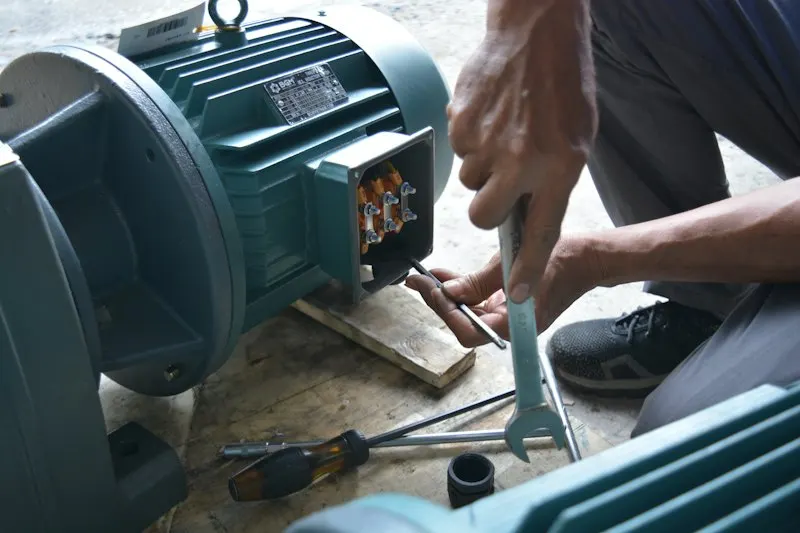
 Testing
Insulation resistance testing is one of the quickest ways to learn about the condition of a winding. It is non-destructive, it takes minutes, and it gives the shop a baseline before any work begins. The reference document for rotating machinery is IEEE Std 43, the recommended practice for testing insulation resistance of electric machinery.
The two numbers
Insulation resistance (IR) is measured by applying a DC voltage between the winding and the frame and reading the resistance, usually after one minute (IR1). Because insulation resistance falls sharply as temperature rises, readings should be corrected to a common base temperature of 40 °C before they are compared with limits or with earlier tests.
The polarization index (PI) is the ratio of the ten-minute reading to the one-minute reading:
PI = IR10 min ÷ IR1 min
In clean, dry insulation the current keeps falling as the material polarizes, so resistance rises over time and the PI is well above one. Moisture or contamination provides a leakage path that does not change with time, which pulls the PI down toward one.
Typical minimums
IEEE 43 gives recommended minimum values that are widely used as acceptance limits:
- Polarization index: at least 1.5 for class A insulation and at least 2.0 for class B, F and H.
- IR1 min at 40 °C: about 100 MΩ for most windings made after 1970, including form-wound coils, and about 5 MΩ for random-wound machines and form-wound machines rated below 1 kV.
- Older windings: the long-standing guideline of the rated voltage in kV plus 1, in MΩ.
The standard also notes that when the one-minute resistance is very high, above roughly 5000 MΩ, the PI may not be a meaningful indicator.
From reading to decision
An IR or PI result on its own is a snapshot. Its real value comes from trend and context: the reading on arrival, after cleaning and drying, and before the unit ships. In Motrix, the test voltage, the readings, the winding temperature and the corrected values sit on one form, the PI is calculated automatically, and results below your limits are flagged before the work order can move on.
 Regulation
 Repair
 Reliability